Thursday, 7 May 2015

BEAUTY

Bill

This is a picture of a 1980 Citroen Maserati. The bloke standing in front of it is ex-Rolling Stones Bass Guitarist, Bill Wyman. I nicked the image from Martin Colyers’ great Blog.

Is it still beautiful?

Might be but very few motor cars can stand that test. A good friend owns an E-Type, don’t know what year and thinks it a thing of wonder; but not me. Only a Porsche 911 has the timelessness.


Wednesday, 6 May 2015

JINDABYNE

Image result for aboriginal art lizard

I’ve been doing a lot of moaning and minging recently; didn’t like that film; found this book full of plot-holes, on and on not giving anyone the benefit of the doubt but today I watched a terrific film so I thought I should report on what sort of thing I can get excited about.
Jindabyne is an Australian film starring Laura Linney and Gabriel Byrne; it was BBC 2 Film of the Week so we gave it a go. Utterly brilliant; Laura Linney grabs all the best scenes but Byrne does good as a washed-up racing driver running a crummy garage cum filling station in nowheresville, the Jindabyne of the title.
It is notionally about the domestic and legal fallout after the body of an Aboriginal girl, a victim of a serial killer . . . is discovered by four friends on a fishing trip. Byrne plays one of the friends and proposes to tether the floating body in the river, continue with the fishing trip and report the body to the police on Sunday when the trip is over. He lives year to year for this male-bonding fishing expedition and doesn’t want it spoiled.
Then they get home.
Then things unravel. Laura Linney who plays the wife is horrified by what they have done, as indeed are most of the citizens in the tiny town; the newspapers get hold of it and the four men are all over the front pages, described as insensitive sickos. Their marriage and their male-bonded friendships go into free-fall and that is really what the film is about; how you think you know and love someone until some incident, some lapse, some crisis brings out an aspect you never dreamed was there and makes you question everything about that person and what you thought you loved about them.
Is it intense, then? ‘Fraid so.
Disturbing and mysterious, I absolutely loved it; welded to the television for two hours.


Tuesday, 5 May 2015

MORTON CASTLE

Image result for morton castle thornhill

We went to Morton Castle, nr Dumfries in Scotland today. What a remote place, even the Historic Scotland guidebook says it is difficult to locate . . .’finding it is an adventure in itself’. There is not one single signpost to it, until you arrive at the actual field-gate where they have put up a tiny board announcing that yes, this is Morton Castle.
It’s in ruins but they have erected a visitors illustration inside showing what the Great Hall must have looked like so you do get a sense of how it must have been. To be honest, Scotland is full of wonderful castles and this is not the most dramatic, beautiful or bloody. The guide admits as much when it says that the castle isn’t particularly interesting, that the setting is the feature visitors come to see. It does have a dramatic setting amongst blue-green hills, surrounded on three sides by the loch. It was raining when we arrived and didn’t really let up but the rain and the gloom and of course we were the only visitors, all added to the breathtaking scene.
You can hear the wind.
I’ve visited several Scottish castles over the years. One of my favourites is Hermitage Castle which is featured in my first novel, RICCARTON JUNCTION. This is another rarely-visited castle, dating I think from the early thirteen hundreds, as is Morton Castle but it doesn’t have anything like the same dramatic setting. Many dastardly deeds were done there however and the gloom and oppressive atmosphere still pervades, even on a sunny summers day.
Dunvegan Castle on the Isle of Skye has a beautiful setting, perhaps the best of all of Scotland’s Castles; Crathes, in Aberdeen is a beautiful building in its own right but it is another Aberdeenshire castle, Dunnotter Castle that is my favourite Scottish castle. It hangs off the edge of a cliff and you have to walk for ever to reach it from the road, so usually you are the only one there because no-one else can be bothered to make the effort. I can remember my father taking me there as a child. My dad was from Aberdeen, so he knew about it and a little of its history. In those days, it wasn’t subject to health and safety like ruins are today so it was pretty-much the ruin left behind after 1685, when two-hundred Covenanters were locked in the vaulted cells and left to die of starvation. The iron grilles through which they could be heard begging for water were still in place then.
Stones can sometimes convey a sense of history and I felt it as a child but the last time I went to Dunnotter, that sense of tragedy had all but been tidied away by Historic Scotland. I think though, that Dunnotter for the very first time in my life brought me face to face with horror; it wasn’t difficult to imagine women and children locked away in that dungeon until they died; in rags and lice-ridden, emaciated, sick, starved and imprisoned by cruel men. Real cruelty and real life, not something in a comic or a story-book. Made a huge impression which I can bring to mind even sixty-years later.

Monday, 4 May 2015

THE GARDEN OF COSMIC SPECULATION


Image result for the garden of cosmic speculation dumfries scotland


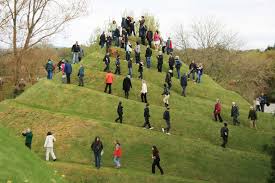
We went to the Garden of Cosmic Speculation today, in Thornhill, nr Dumfries. Famously Brigadoon-like in that it is only open for one day a year. Today was the day.

Insanity. Because they choose to only open for one day they get 20000 visitors so you can’t move; can’t see the bloody garden for throngs of people in wellies. Parking is a mini-nightmare and getting out of the car park in a heavy rain like it was today, churned-up mud and Minis up to their axles, makes you question whether it was worth the effort. It is well done though and by getting there early, very early, we were able to get a sense of the beautiful rhythms of the landscaping without the crowds of kids running wild all over it. It was designed by Charles Jencks, an American landscape gardener, it says here. I am dubious; felt like a Stirling-Wilford situation to me with one person the genius and the other the workhorse who gets the genius’ ideas actually built and implemented.

In the brochure, it says, The lakes were designed by Maggie Keswick and the landscaping by her husband Charles Jencks. Is that true? Maggie was a descendant of the fabulously wealthy Jardine Mathieson family, then and now one of the richest families in Scotland. They made their money by selling opium to the unsuspecting Chinese in the mid-nineteenth century. Presumably that is where the money for this project originated. Maggie lived in China and spoke Chinese; she wrote a well-received academic book in 1978, when she must have been about thirty-six, thirty-seven called, The Chinese Garden  which the New York Times reviewed as ‘a first-rate job of intellect, intelligently illustrated’. It is so highly regarded apparently that it is still in print.

I think she must have visited and studied the Emperor’s Old Summer Palace and the Ruins of the Magnanimous World in Northern China, a place I went to in 1980. Although there was not a lot to see there now [it was completely destroyed by British troops protecting their opium trade in 1860] you could still locate the lakes and artificial landforms, originally constructed by the Chinese. I haven’t read The Chinese Garden, to be honest I haven’t got the time or the interest but I would guess that the Garden of Cosmic Speculation was much-influenced by Maggie’s thoughts and experiences. I see also that she studied at the AA, the Architectural Association after leaving Oxford where only the crème de la crème are allowed through the doors.

But of course she is dead now, she died of cancer in 1995 so isn’t around to take the credit she is due. So now we get, ‘The lakes were designed by Maggie Keswick and the landscaping by her husband Charles Jencks’.

That isn’t to minimise his contribution. It is a herculean undertaking; try getting a bulldozer driver to create a curvy sensuous hill exactly this height, exactly this long in Scotland in the nineteen nineties. And a tongue of land into a lake just this long and no longer.

I knew Wilford, vaguely. He wouldn’t remember me but we spoke on the phone a lot and corresponded by letter particularly on their disastrous Runcorn New Town project. We did a fair bit of work for Stirling [no credit to me, by the way]: Runcorn, as I say, their other beautiful disaster, the Florey Building in Oxford; Olivetti, I remember very well. Anyway, my point being that Wilford was the guy who got them built and that is no small achievement and I am sure he must have found it incredibly frustrating that Stirling got all the credit and was hailed as the genius. But such is the fall of the dice and claiming credit after Maggie is no longer around doesn’t seem quite right.

Now he tinkers. The mark of the non-genius; tinkering. He should leave it be.

Pure.